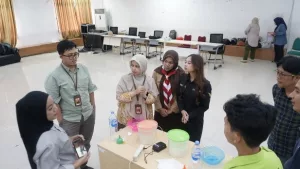
In an effort to answer the challenges of food security, energy, water, and environment, as well as strategic issues in Lampung Province such as poverty, unemployment, and stunting, ITERA conducted a themed socialization event on cassava hilirisasi innovation through the development of Modified Cassava Flour (MOCAF), held on 4 March 2026 at the GKU 1 ITERA hall.
Lampung is known as one of the largest cassava production centers in Indonesia. However, until now, this sector is still dominated by raw basic material production with low added value. The lack of medium-sized processing industry and the lack of product diversification caused the farmers’ bargaining position to be relatively weak and dependence on limited markets.
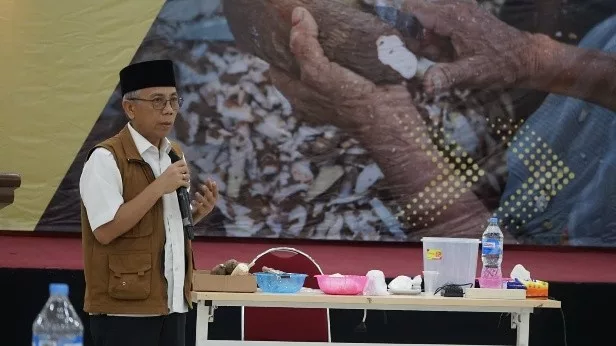
In his presentation, Prof. I Nyoman Pugeg Aryantha highlighted the latest dynamics regarding the cassava price determination policy of Rp1.350/kg. “The policy of Rp1.350 per kilogram actually aims to protect farmers from continuing to sell at low prices. However, in the field, the processing industry has not been able to absorb raw materials at that price. When the industry does not buy, cassava is not sold. This then triggered protests and caused some farmers to choose not to plant again,” he explained.
He added that the problem showed the importance of a structural solution, not just a mere price policy. As a strategic solution, this activity raised the MOCAF (Modified Cassava Flour) innovation as a form of cassava processing with high and sustainable added value.
MOCAF is a modified cassava flour produced through fermentation using lactic acid bacteria such as Lactobacillus and Bifidobacterium. Through this process, complex starch in cassava is converted into a simpler carbohydrate (oligosaccharide), thus producing a product that is gluten-free, easier to digest, has potential as a prebiotic, and has a higher selling value than raw cassava.
The MOCAF production process introduced did not only focus on flour as the main product, but also carried the concept of integrated production based on zero waste. Its stages include raw material preparation and peeling, grating or shredding, fermentation, starch precipitation, to separation into MOCAF, probiotic solution, and other byproducts. The resulting cassava waste is then dried and fermented using Trichoderma to be used as animal feed (tempe or mocaf bungkil). Meanwhile, the fermentation water can be utilized as animal probiotic and reused as the next fermentation starter. The outer skin of cassava is also not wasted, but dried and processed with the addition of lime powder to produce an alternative material that has potential as an environmentally friendly fire extinguishing agent.
As explained by Prof. I Nyoman Pugeg Aryantha, the concept is not merely making flour, but building an integrated cassava-based industrial ecosystem that is waste-minimized. If this is developed seriously, the impact could be significant for farmers’ welfare and job creation. Through this MOCAF innovation, it is hoped that the added value of local commodities will increase, the growth of medium-sized processing industry in Lampung will occur, and real contribution to food security and stunting reduction. This activity became a momentum for collaboration between academics, farmers, industry, and government in building a sustainable and competitive Lampung cassava agroindustry.